Trade S&P 500 Online for Beginners: Step-by-Step Guide Updated for 2026
Online S&P 500 trading guide for beginners in 2026. Complete step-by-step, no KYC required, trade 24/7 with risk management techniques. Start trading on SiamDEX today.
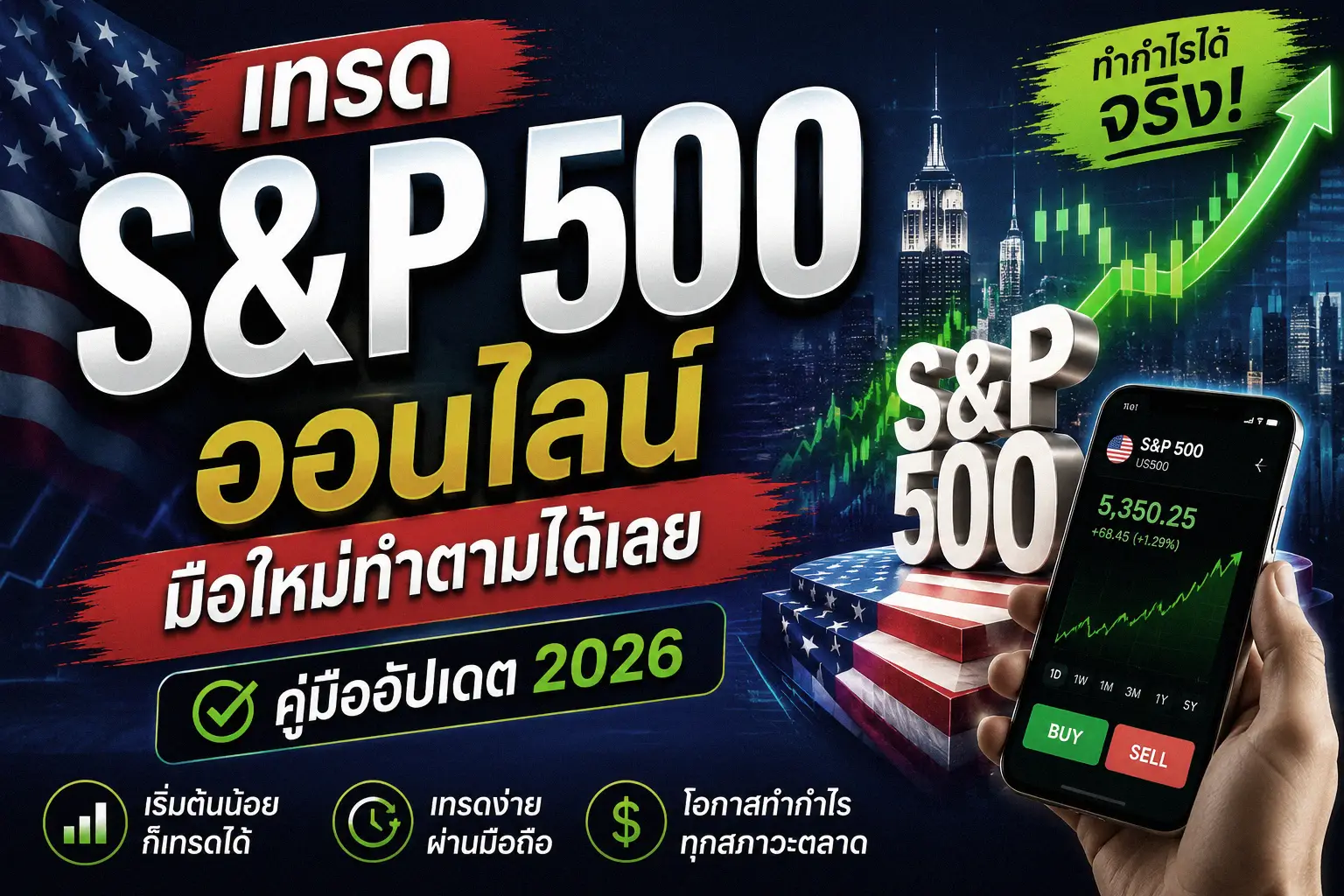
Trading the S&P 500 online has become one of the top goals for Thai investors in 2026 because this largest US stock index reflects the growth of the world's top 500 companies, ranging from Apple, Microsoft, Nvidia to Tesla and Berkshire Hathaway. However, the recurring problem that beginner Thai traders face is opening accounts with foreign brokers, which requires submitting a mountain of KYC documents, waiting for weeks, paying expensive FX fees for bank transfers, and worst of all, the US stock market is closed on weekends, causing them to miss key opportunities when major news breaks outside trading hours. This article will guide you through trading the S&P 500 in an easy-to-understand, actionable way, featuring the latest 2026 updates that completely eliminate all previous obstacles.
What is the S&P 500 and Why Should Thai People Care in 2026?
The S&P 500 (Standard & Poor's 500) is an index that compiles the 500 public companies with the highest Market Cap in the US stock market, covering approximately 80% of the entire US stock market value. To put it simply, if the US economy is doing well, this index goes up, making investors worldwide use the S&P 500 as a benchmark to measure their portfolio performance.
Historical Returns Attracting Thai Investors
Over the past 30 years, the S&P 500 has delivered an average return of about 10-11% per year (including dividends), which is several times higher than depositing money in Thai banks that offer less than 2% interest, and it has also outperformed the SET Index in Thailand, which has moved sideways for a long time. In 2024-2025, the S&P 500 index continuously hit All-Time Highs driven by the AI Boom and the Fed's interest rate cuts, propelling tech companies like Nvidia, Microsoft, and Alphabet to surge rapidly.
Why Index Trading is More Suitable for Beginners Than Individual Stocks
- Built-in Diversification: Buying one unit of the S&P 500 is equivalent to holding 500 companies simultaneously.
- No Need to Analyze Individual Financial Statements: Just looking at the macroeconomic picture is enough.
- Very High Liquidity: Enter and exit positions at any time without heavy slippage.
- Lower Volatility Than Individual Stocks and Crypto: Ideal for those who are just starting out.
Traditional Issues Thai Traders Faced When Wanting to Trade the S&P 500
Before 2026, Thai people who wanted to trade US indices usually had to choose between two paths: opening an account with a Thai broker that offers a DR (Depository Receipt) of an ETF like SPY, or opening an account directly with a foreign broker. Both paths have the following limitations:
Limitations of Traditional Thai and Foreign Brokers
- Complex KYC: Must submit passports, utility bills, historical bank statements, and some places even require a W-8BEN form from the US IRS.
- Hidden Fees: FX fees for transferring Thai Baht to Dollars of 1-2%, commission fees per order, and inactivity fees when not trading.
- Limited Trading Hours: The US stock market opens from 21:30 to 04:00 (Thai time) and closes on weekends, causing traders to miss big news.
- Withholding Tax: Dividends from US stocks are subject to a 30% tax deduction before entering the account.
- Custody Risk: Funds and assets are kept with the broker. If the broker collapses, as in the FTX case, recovery is very difficult.
The New Solution in 2026: Trade S&P 500 on SiamDEX with Self-Custody
SiamDEX is a multi-asset trading platform powered by the Hyperliquid Engine, which is the decentralized perpetual exchange with the highest trading volume in the DEX world. The special feature is that in addition to trading crypto, it also allows trading stock indices (including the S&P 500), gold, oil, and Forex currency pairs all in one place, while users still control their own funds through private wallets without depositing money with large custodians.
5 Core Strengths that Make SiamDEX Answer the Needs of Beginners
- No KYC Required: Connect a wallet and start trading within 30 seconds, no document submission needed.
- Trade 24/7 Without Holidays: Weekends or US public holidays can be traded normally.
- Self-Custody: Funds remain in your wallet at all times. SiamDEX cannot freeze or seize your money.
- CEX-Level Speed: The Hyperliquid Engine processes orders at 200,000 TPS with a latency of less than 1 second.
- Very Low Fees: Maker fee starts at 0.01%, Taker fee is 0.035%, dozens of times cheaper than traditional stock brokers.
Tradable Assets on a Single Platform
In addition to the S&P 500 (symbol SPX), you can also instantly trade other assets in the same account, such as Bitcoin (BTC), the world's number 1 digital asset, Ethereum (ETH), which powers the DeFi ecosystem, and Gold (GOLD) for inflation hedging. Switching between assets can be done in 1 click, no need to open multiple headache-inducing accounts.
Step-by-Step S&P 500 Trading Guide on SiamDEX for Beginners
Follow these 5 steps, and you will be able to start trading SPX within 10 minutes.
Step 1: Prepare a Crypto Wallet
Download a wallet that supports Web3, such as MetaMask, Rabby, or Phantom (for Solana users). Install it as a browser extension or mobile app, then save the 12-word seed phrase in a safe place. Never take a photo or store it on a computer connected to the internet.
Step 2: Fund Your Wallet with USDC
USDC is a stablecoin pegged 1:1 to the US dollar, used as collateral for trading. You can buy USDC from Thai exchanges like Bitkub, Binance TH, or use direct on-ramp services within the platform. It is recommended to start with an amount you are fully prepared to lose, such as 100-500 USDC for practice.
Step 3: Connect Your Wallet to SiamDEX
Go to the siamdex.com website, click the Connect Wallet button in the top right corner, and select the wallet you use. The system will ask you to sign a message to verify your identity. This signing is not a money transfer; it is merely proof that you actually own the wallet. Transfer USDC from your main wallet to your trading account in 1 click.
Step 4: Select the SPX Trading Pair and Configure Your Order
Click on the search bar, type "SPX" or "S&P 500", and the system will display the SPX-USD Perpetual trading pair. There will be important data to look at:
- Mark Price: The current price of the index, referenced from multiple oracle sources.
- Funding Rate: The interest rate that Longs and Shorts pay each other every 8 hours.
- Open Interest: The value of outstanding contracts, reflecting market interest.
- Leverage: Selectable from 1x-20x. It is recommended that beginners start at 2x-3x only.
Fill in the position size, then select Long if you think the index will go up, or Short if you think it will go down.
Step 5: Set Stop-Loss and Take-Profit Every Time
This is the step that beginners often forget, leading to heavy losses. The golden rules are:
- Stop-Loss: Set it 1-2% away from the entry point to limit losses.
- Take-Profit: Set it at least 2-3 times the distance of the Stop-Loss (Risk:Reward 1:2 or 1:3).
- Do not use leverage exceeding 5x in the first year: To prevent liquidation from normal volatility.
Comparing SiamDEX with Other Channels for Trading the S&P 500
SiamDEX vs Foreign CFD Brokers (XM, Exness)
Traditional CFD brokers require full KYC, taking 1-3 days for approval, and have a conflict of interest because the broker is the direct counterparty to the customer. If the customer makes too much profit, the broker might close the account or cause heavy slippage. Conversely, SiamDEX uses a real order book on Hyperliquid, ensuring that the price obtained is the genuine market price without dealing desk intervention.
SiamDEX vs Thai ETFs (DR of SPY)
DRs traded on the Thai stock market can only be traded from 10:00 to 16:30 and have a minimum commission fee of 50 Baht per order, making them unsuitable for day trading. Meanwhile, SiamDEX allows 24/7 trading, with fees calculated directly as a percentage of the position value with no minimums, and allows opening short positions immediately when the market is in a downtrend.
SiamDEX vs CEX (Binance, Bybit)
Centralized exchanges like Binance or Bybit also have SPX Perpetuals, but they have mandated KYC in Thailand since 2024 and have a history of freezing user accounts in countries on sanctions lists. SiamDEX remains non-custodial at all times; no one can freeze your money.
Precautions and Risks Beginners Must Know
Even though SiamDEX eliminates many traditional problems, trading leveraged assets still carries risks that must be understood:
- Liquidation Risk: If the price moves against your position too much, the margin will be forcibly liquidated, losing all collateral money.
- Accumulated Funding Rate: If holding a position for many days during an intensely bullish market, you might have to pay accumulated funding that amounts to a significant percentage.
- Smart Contract Risk: Even though Hyperliquid has passed multiple audits, DeFi still carries code exploit risks that traditional exchanges do not have.
- Wallet Security: If you lose your seed phrase, no one can help you recover it. Responsibility lies 100% with the user.
- Taxes in Thailand: Profit from trading perpetuals is considered income subject to tax under Thai law. It is recommended to keep records of every transaction.
Tips for Beginners Who Want to Trade the S&P 500 Profitably in the Long Run
Trading an index is different from trading crypto in that the S&P 500 moves in line with the macroeconomy rather than market hype. Practical tips include:
- Follow FOMC Meetings: The Fed meetings every 6 weeks heavily impact the direction of the SPX.
- Watch the VIX (Volatility Index): VIX above 25 = market fear, below 15 = market complacency.
- Beware of Earnings Season: Every quarter, big tech companies report earnings, immediately affecting the SPX.
- Avoid Trading on Friday Evenings: Volatility often decreases, and spreads widen.
- Keep a Journal for Every Trade: Record reasons for entry and exit to develop yourself.
Conclusion: 2026 is the Best Time to Start Trading the S&P 500
Trading the S&P 500 is no longer a distant matter for Thai people. With Decentralized Exchange technology on the Hyperliquid Engine provided by SiamDEX, you can bypass all traditional obstacles regarding KYC, FX fees, trading hours, and custody risk on a single platform. Start with a small capital, learn the system, practice the discipline of setting a stop-loss, and increase your position size when you feel confident in your strategy.
Ready to start trading the S&P 500 24/7? Connect your wallet to SiamDEX today and explore other assets, including Bitcoin, Ethereum, and Gold, all within the same account. No holidays, no KYC, no intermediaries.
Written by
Related Articles
Before You Trade
Level Up Your Knowledge First
Smart traders do their research first. Read our articles and latest news before placing your first trade.
Educational Blog
Learn trading fundamentals to advanced strategies for crypto, stocks, and more.
Latest Market News
Stay updated on crypto, stocks, and macro news to time the market better.
Successful traders spend 80% of their time studying the market and 20% actually trading. Don't rush.
วิธีเทรด
และอีก 200+ รายการ




Assets You Can Trade
 Bitcoin (BTC)
 Ethereum (ETH)
 Solana (SOL)
 Hyperliquid (HYPE)
 Gold (PAXG) (PAXG)
 XRP (XRP)
 Dogecoin (DOGE)
 Fartcoin (FARTCOIN)
 Zcash (ZEC)
 Bittensor (TAO)
 Plasma (XPL)
 Pump.fun (PUMP)
 Pepe (1000x) (KPEPE)
 Sui (SUI)
 Venice Finance (VVV)
 Algorand (ALGO)
 Litentry (LIT)
 Chainlink (LINK)
 Cardano (ADA)
 Monad (MON)
 Jupiter (JUP)
 Ethena (ENA)
 Avalanche (AVAX)
 LayerZero (ZRO)
 Blur (BLUR)
 Ondo Finance (ONDO)
 dogwifhat (WIF)
 Pudgy Penguins (PENGU)
 SPX6900 (SPX)
 Bonk (1000x) (KBONK)
 dYdX (DYDX)
 TRON (TRX)
 Starknet (STRK)
 Story Protocol (IP)
 Render Network (RENDER)
 AIXBT by Virtuals (AIXBT)
 Aerodrome Finance (AERO)
 Just a Chill Guy (CHILLGUY)
 Aave (AAVE)
 BNB (BNB)
 Curve Finance (CRV)
 Monero (XMR)
 NEAR Protocol (NEAR)
 Aster (ASTER)
 Worldcoin (WLD)
 Uniswap (UNI)
 Bitcoin Cash (BCH)
 Sei (SEI)
 Aptos (APT)
 Litecoin (LTC)
 Lido DAO (LDO)
 World Liberty Financial (WLFI)
 Arbitrum (ARB)
 Stellar (XLM)
 Virtuals Protocol (VIRTUAL)
 Official Trump (TRUMP)
 Fetch.ai (ASI) (FET)
 Morpho (MORPHO)
 Hemi Network (HEMI)
 Polkadot (DOT)
 0G (ZeroGravity) (0G)
 DoubleZero (2Z)
 ACE (Fusionist) (ACE)
 ApeCoin (APE)
 Axie Infinity (AXS)
 Bio Protocol (BIO)
 BLAST (BLAST)
 BOOK OF MEME (BOME)
 Conflux (CFX)
 Brent (BRENTOIL)
 GOLD (GOLD)
 SILVER (SILVER)
 Nvidia (NVDA)
 Apple (AAPL)
 Tesla (TSLA)
 S&P 500 (SP500)
 WTI (CL) (CL)
 Nasdaq 100 (XYZ100)
 SanDisk (Western Digital) (SNDK)
 Circle (CRCL)
 Micron Technology (MU)
 Intel (INTC)
 Natural Gas (NATGAS)
 EUR (EUR)
 Platinum (PLATINUM)
 Coinbase (COIN) (COIN)
 iShares MSCI South Korea ETF (EWY)
 JPY (JPY)
 Alphabet (Google) (GOOGL)
 Robinhood (HOOD)
 Palantir (PLTR)
 Copper (COPPER)
 MicroStrategy (MSTR)
 Meta (Facebook) (META)
 Microsoft (MSFT)
 CrowdStrike (CRWV)
 Amazon (AMZN)
 SK Hynix (SKHX)
 Netflix (NFLX)
 Advanced Micro Devices (AMD)
 Eli Lilly (LLY)
 ARM Holdings (USAR)
 TSMC (TSM)
 Oracle (ORCL)
 iShares MSCI Japan ETF (EWJ)
 Rivian (RIVN)
 Alibaba (BABA)
 Samsung Electronics (SMSN)