Is DEX More Dangerous Than CEX? The Truth Many Don't Know
A straightforward comparison of DEX vs. CEX security: who really holds your money, what FTX taught us, and why a DEX like Hyperliquid might be safer than you think.
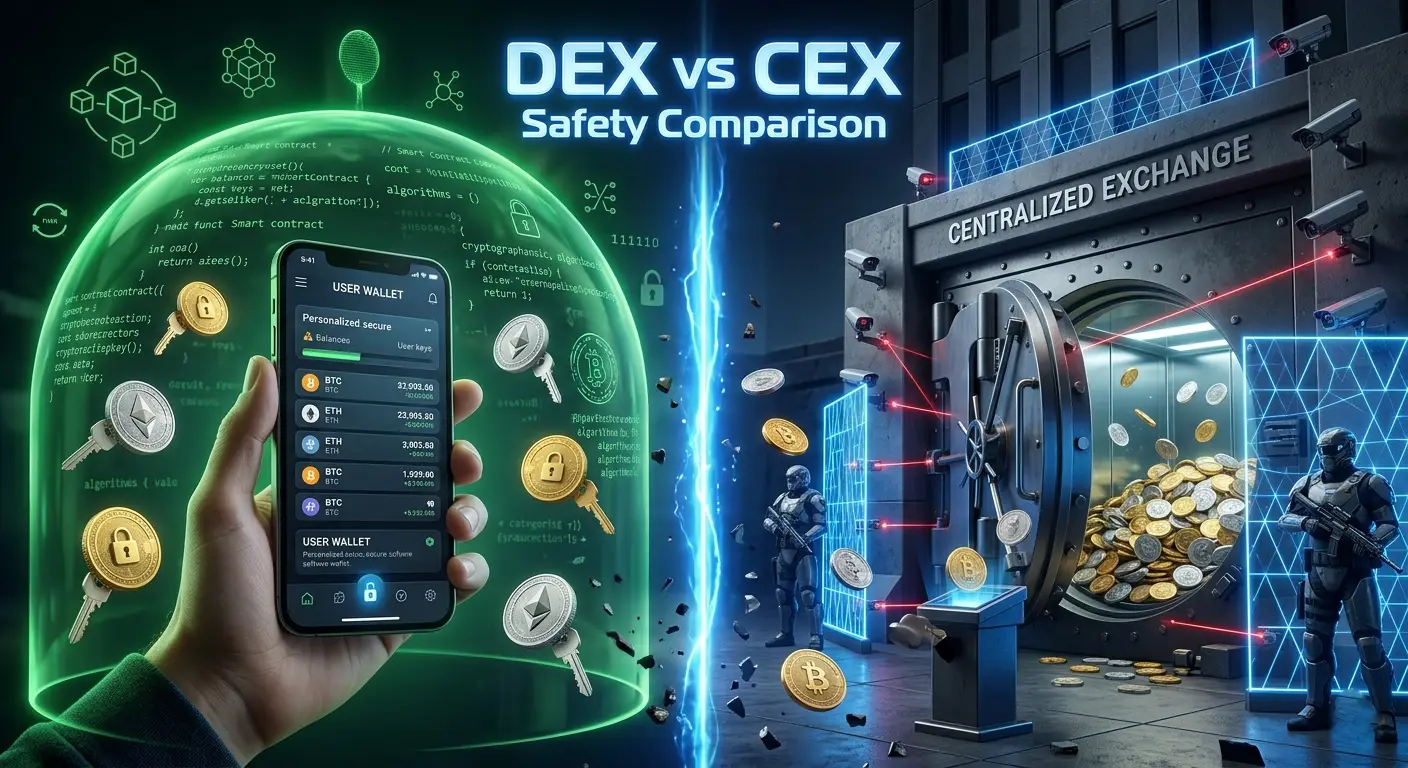
Introduction — Why are people afraid of DEXs?
Every time there is news of a DeFi hack or a protocol attack, a common wave of thought follows: 'DEXs are dangerous and untrustworthy; it’s better to use a CEX with a company taking care of things.'
At first glance, this idea seems logical. However, if you look at the actual data from both sides, the reality might completely flip your beliefs.
This article will compare DEXs and CEXs straightforwardly, without favoring either side, but analyzing what the true risks of each are and how you should manage them.
What is a CEX and who really holds your money?
A CEX, or Centralized Exchange, is an exchange operated by a company, such as Binance, Coinbase, Bitkub, or OKX. The way it works is you deposit money into the exchange's account, and the exchange holds your assets on your behalf.
Simply put: you don't truly hold your own crypto. What you have is an IOU, or a promise that the exchange will return your money when you want it. This means that if the exchange has a problem, your money has a problem too.
In the crypto world, there is a famous saying: 'Not your keys, not your coins.' This means if you don't hold your own private keys, that money isn't truly yours.
What FTX taught us — the most expensive lesson in crypto history
If we are talking about CEX risks, we must talk about FTX because it is the clearest case study.
FTX was once the 2nd or 3rd largest exchange in the world. Its CEO, Sam Bankman-Fried, was praised by media and institutional investors globally. Everything looked trustworthy: they had investment from top VCs, partners in various famous sports, and were licensed in many countries.
Then, in November 2022, everything collapsed within a week. It was revealed that FTX took user funds to use in loss-making trades. Investors worldwide lost a combined total of over $8 billion, and SBF was sentenced to 25 years in prison.
What's notable is that FTX looked much more trustworthy than most DEXs in the eyes of general investors. It had a team, an office, licenses, and audits—but none of that prevented the fraud.
FTX isn't the only case. Before that, there was Mt. Gox in 2014, which vanished with over 850,000 BTC of user funds; QuadrigaCX in 2019; Celsius in 2022; and many other cases. Altogether, the money lost from CEX bankruptcies or scams totals tens of billions of dollars.
How DEXs work differently
A DEX, or Decentralized Exchange, such as Hyperliquid, Uniswap, or GMX, operates directly via smart contracts on the blockchain. No company holds your money for you.
When you trade on a DEX, the process looks like this: you connect your own wallet to the protocol. When you make a trade, a smart contract manages the transaction automatically based on the logic written in the code. Assets enter your wallet directly after the trade is finished. No company or individual has the power to manage your money.
The main advantage is no counterparty risk. That is, you don't have to trust an exchange team not to run away with the money because they never had your money in the first place.
Hyperliquid, which SiamDEX uses as a backend, is a great example. it is a purpose-built chain designed specifically for trading, using an on-chain order book. This differs from typical DEXs that use AMMs (Automated Market Makers), resulting in liquidity and execution that are much closer to a CEX.
So what are the DeFi hacks we see in the news?
This is the part where we must be blunt: DEXs and DeFi protocols do indeed have risks from hacks. However, the nature of the risk is very different from a CEX.
Main DEX risks fall into 3 major categories:
- Smart Contract Bug: Errors in the code that allow an attacker to find a loophole to drain funds. This is common in new projects that haven't been thoroughly audited.
- Oracle Manipulation: Manipulating prices from external data sources (oracles) to trick the protocol into thinking an asset is worth more than it is. The Drift Protocol case in 2026, which lost over $285 million, is a clear example. Attackers used a self-created fake token called CarbonVote as collateral and used social engineering to trick multisig members before draining the funds in 12 minutes.
- Governance Attack: Attacks via the protocol's governance system, such as accumulating voting power to pass proposals that benefit the attacker.
What is worth noting is that mature protocols that have been thoroughly audited are much less likely to be hacked. Uniswap, the world's largest DEX, has never had its core contract hacked in the past 6 years. Similarly, Hyperliquid has never lost user funds due to a protocol hack since its launch.
Direct Comparison — The risks of each side
Let's look clearly at what the risks are for each side.
CEX Risks:
- Exchange bankruptcy or insolvency (e.g., FTX, Celsius).
- Exchange team fraud or exit scams.
- Government orders to seize or shut down the exchange in the country.
- The exchange's security system is hacked and hot wallets are drained.
- Exchanges freeze withdrawals during a crisis, as Celsius did before its collapse.
DEX Risks:
- Smart contracts have vulnerabilities in the code.
- Oracle manipulation.
- Governance attacks.
- User error, such as sending money to the wrong address or approving a malicious transaction.
- The protocol is new and hasn't been sufficiently audited.
A key observation is that CEX risks usually affect all users at the same time. When FTX collapsed, everyone who had deposited money was affected simultaneously. However, DEX risks are often more specific, such as only the protocol that was attacked, or only the user who approved a dangerous transaction.
How safe is Hyperliquid?
Since SiamDEX uses Hyperliquid as its backend, I want to address this directly.
Hyperliquid is an L1 blockchain designed specifically for trading. It is not a protocol deployed on Ethereum or other chains, allowing it to have more comprehensive control over its security model.
Since its launch to the present, Hyperliquid has never had an incident where user funds were lost due to a protocol exploit. It has a daily trading volume exceeding $10 billion and a TVL of over $1.7 billion. These figures indicate that institutional and professional traders place a high level of trust in this protocol.
However, to be honest, no protocol is 100% without risk. Risks to be aware of include Hyperliquid's use of a relatively small validator set, which could pose decentralization risks, and the possibility that the smart contract or infrastructure might have undiscovered vulnerabilities. But compared to CEXs, which have direct counterparty risk, these risks are clearly different in nature.
How to manage risks wisely
Instead of asking whether a DEX or CEX is more dangerous, a better question is how to manage the risks of each side to suit yourself.
- Don't deposit more money on a CEX than necessary for trading: Keep the majority in a self-custody wallet like a Ledger or MetaMask.
- On a DEX, be careful with the transactions you approve: Read everything before clicking confirm and only use trusted protocols with a good track record.
- Diversify risk: Don't keep all your money in one place, whether it's a CEX or a DEX.
- Use a hardware wallet: For long-term crypto holdings, a hardware wallet like a Ledger is the safest choice.
- Verify before approving: Revoke unused approvals using tools like Revoke.cash to reduce risk from malicious contracts.
- Choose protocols with a good history: Protocols that are older, have high TVL, and have been audited by reputable firms are usually safer than new, untested protocols.
Summary — No side is 100% safe
The most straightforward answer is both DEXs and CEXs have risks, but they are different types of risk.
CEXs have counterparty risk, which means you have to trust the company holding your money to manage it honestly. Crypto history has shown many times that this is a very high-risk trust.
DEXs have technical risks, such as smart contract bugs or oracle manipulation, which can be mitigated by choosing protocols with a good history, that are audited, and by avoiding new, untested protocols.
If you ask whether FTX or Hyperliquid was more dangerous, the answer should be clear by now.
If you're ready to try trading on a DEX with the highest liquidity in the world, come to siamdex.com. Connect MetaMask and trade immediately. No KYC, no need to deposit money with any company, and withdraw back to Baht via Bitkub 24 hours a day.
Written by

SiamDEX's team of DeFi and financial market experts with over 5 years of experience trading crypto and digital assets.
Related Articles
Before You Trade
Level Up Your Knowledge First
Smart traders do their research first. Read our articles and latest news before placing your first trade.
Educational Blog
Learn trading fundamentals to advanced strategies for crypto, stocks, and more.
Latest Market News
Stay updated on crypto, stocks, and macro news to time the market better.
Successful traders spend 80% of their time studying the market and 20% actually trading. Don't rush.
วิธีเทรด
และอีก 200+ รายการ





Assets You Can Trade
 Bitcoin (BTC)
 Ethereum (ETH)
 Solana (SOL)
 Hyperliquid (HYPE)
 Gold (PAXG) (PAXG)
 XRP (XRP)
 Dogecoin (DOGE)
 Fartcoin (FARTCOIN)
 Zcash (ZEC)
 Bittensor (TAO)
 Plasma (XPL)
 Pump.fun (PUMP)
 Pepe (1000x) (KPEPE)
 Sui (SUI)
 Venice Finance (VVV)
 Algorand (ALGO)
 Litentry (LIT)
 Chainlink (LINK)
 Cardano (ADA)
 Monad (MON)
 Jupiter (JUP)
 Ethena (ENA)
 Avalanche (AVAX)
 LayerZero (ZRO)
 Blur (BLUR)
 Ondo Finance (ONDO)
 dogwifhat (WIF)
 Pudgy Penguins (PENGU)
 SPX6900 (SPX)
 Bonk (1000x) (KBONK)
 dYdX (DYDX)
 TRON (TRX)
 Starknet (STRK)
 Story Protocol (IP)
 Render Network (RENDER)
 AIXBT by Virtuals (AIXBT)
 Aerodrome Finance (AERO)
 Just a Chill Guy (CHILLGUY)
 Aave (AAVE)
 BNB (BNB)
 Curve Finance (CRV)
 Monero (XMR)
 NEAR Protocol (NEAR)
 Aster (ASTER)
 Worldcoin (WLD)
 Uniswap (UNI)
 Bitcoin Cash (BCH)
 Sei (SEI)
 Aptos (APT)
 Litecoin (LTC)
 Lido DAO (LDO)
 World Liberty Financial (WLFI)
 Arbitrum (ARB)
 Stellar (XLM)
 Virtuals Protocol (VIRTUAL)
 Official Trump (TRUMP)
 Fetch.ai (ASI) (FET)
 Morpho (MORPHO)
 Hemi Network (HEMI)
 Polkadot (DOT)
 0G (ZeroGravity) (0G)
 DoubleZero (2Z)
 ACE (Fusionist) (ACE)
 ApeCoin (APE)
 Axie Infinity (AXS)
 Bio Protocol (BIO)
 BLAST (BLAST)
 BOOK OF MEME (BOME)
 Conflux (CFX)
 Brent (BRENTOIL)
 GOLD (GOLD)
 SILVER (SILVER)
 Nvidia (NVDA)
 Apple (AAPL)
 Tesla (TSLA)
 S&P 500 (SP500)
 WTI (CL) (CL)
 Nasdaq 100 (XYZ100)
 SanDisk (Western Digital) (SNDK)
 Circle (CRCL)
 Micron Technology (MU)
 Intel (INTC)
 Natural Gas (NATGAS)
 EUR (EUR)
 Platinum (PLATINUM)
 Coinbase (COIN) (COIN)
 iShares MSCI South Korea ETF (EWY)
 JPY (JPY)
 Alphabet (Google) (GOOGL)
 Robinhood (HOOD)
 Palantir (PLTR)
 Copper (COPPER)
 MicroStrategy (MSTR)
 Meta (Facebook) (META)
 Microsoft (MSFT)
 CrowdStrike (CRWV)
 Amazon (AMZN)
 SK Hynix (SKHX)
 Netflix (NFLX)
 Advanced Micro Devices (AMD)
 Eli Lilly (LLY)
 ARM Holdings (USAR)
 TSMC (TSM)
 Oracle (ORCL)
 iShares MSCI Japan ETF (EWJ)
 Rivian (RIVN)
 Alibaba (BABA)
 Samsung Electronics (SMSN)